YEAR
2019
CITY
MOSCOW
SERVICE
CONTENT DEVELOPMENT
THE BRIEF
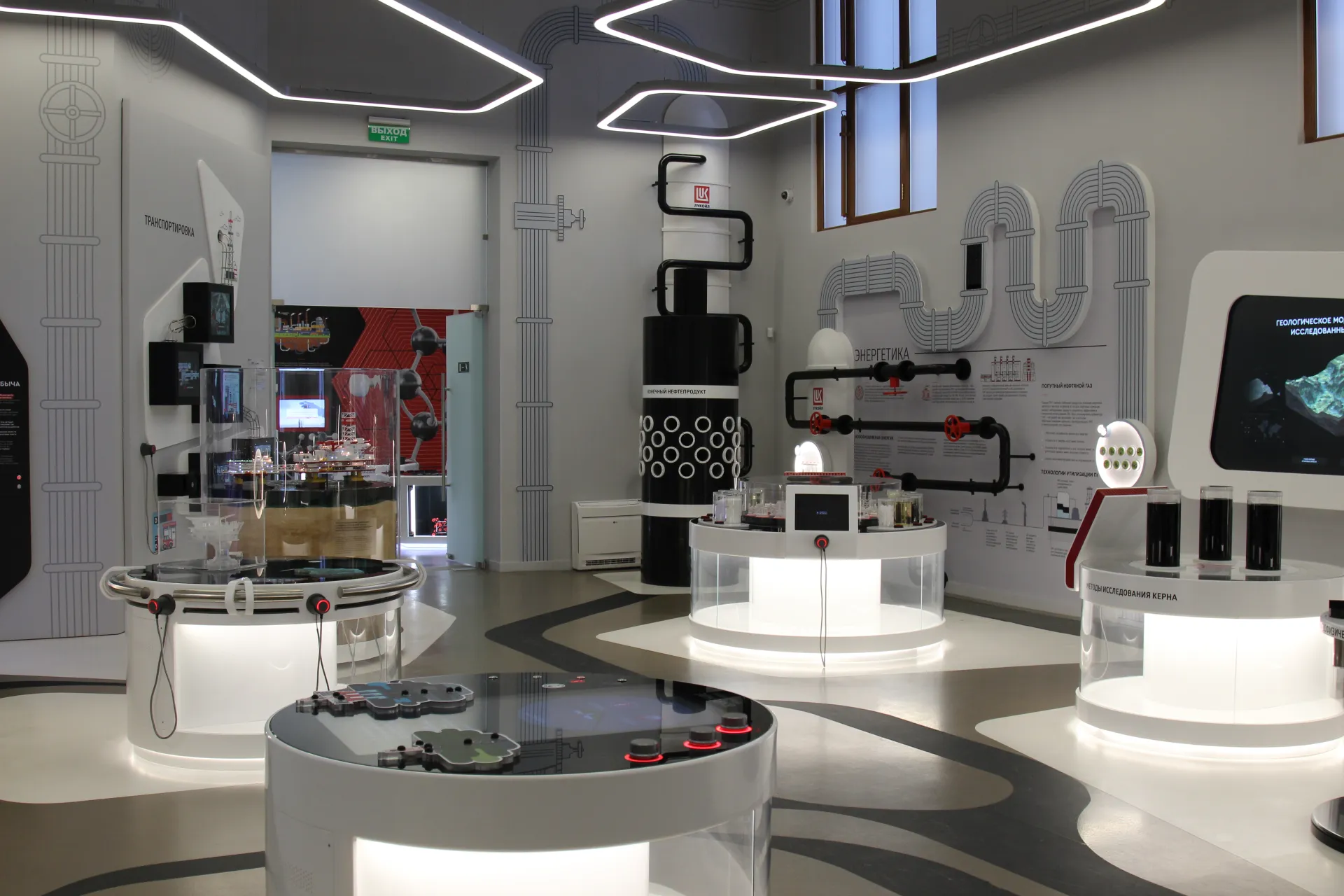
The Oil Museum was conceived as a contemporary scientific and industrial heritage museum dedicated to the history, technologies, geology, and cultural impact of oil extraction and processing.
The institution needed to communicate one of the most complex and politically charged infrastructures of modern civilisation: the global energy systems underpinning industry, transportation, urbanisation, and economic development. Rather than functioning as a corporate showcase or technical archive, the museum was intended to become a public educational platform capable of translating the invisible processes of the oil industry into spatially understandable and emotionally engaging experience.
Pitch was commissioned by Ascreen to develop the multimedia exhibition complex, immersive installations, audiovisual environments, interactive systems, and narrative content integrating scientific explanation, historical storytelling, industrial technologies, and public engagement into one coherent visitor journey.
MY ROLE
I served as Creative Director and Lead Scriptwriter for the multimedia exhibition complex, leading the development of the project from conceptual strategy through implementation.
My role focused on translating highly complex industrial, geological, and technological systems into a coherent visitor experience framework capable of engaging broad public audiences without sacrificing scientific rigor or conceptual depth.
I developed the narrative architecture and interpretive logic connecting geology, extraction technologies, industrial infrastructure, environmental systems, and human experience into one integrated spatial storytelling system. I also directed the research and scriptwriting teams and supervised the development of audiovisual, interactive, and immersive multimedia content across the exhibition.
In close collaboration with scientists, engineers, designers, multimedia artists, and technical specialists, we developed interpretive environments capable of transforming invisible industrial systems into emotionally legible public experience.
THE CHALLENGE
Oil infrastructure is fundamentally difficult to exhibit. Most of its essential processes occur underground, inside pipelines, industrial facilities, laboratories, geological formations, or global logistical systems inaccessible to public perception. Visitors experience the results of energy infrastructure every day while remaining almost entirely disconnected from the systems enabling modern life itself.
The challenge was therefore not simply educational, but interpretive: how do you make geological timescales, extraction technologies, industrial transformation, and planetary-scale infrastructure emotionally and spatially legible to broad audiences without reducing them to technical diagrams or corporate communication?
The project also needed to navigate multiple layers simultaneously: scientific explanation, industrial history, technological innovation, environmental awareness, and human labour.
Rather than presenting oil as a purely technological subject, the exhibition required a narrative framework capable of revealing how energy systems shape cities, economies, landscapes, and everyday existence itself.
At the same time, the museum had to engage radically different audience groups — from industry professionals and engineers to families, children, and visitors with no technical background — requiring highly layered interpretive systems balancing accessibility with scientific depth.


THE APPROACH
The conceptual move was to treat oil not as a resource, but as an invisible operating system of industrial civilisation.
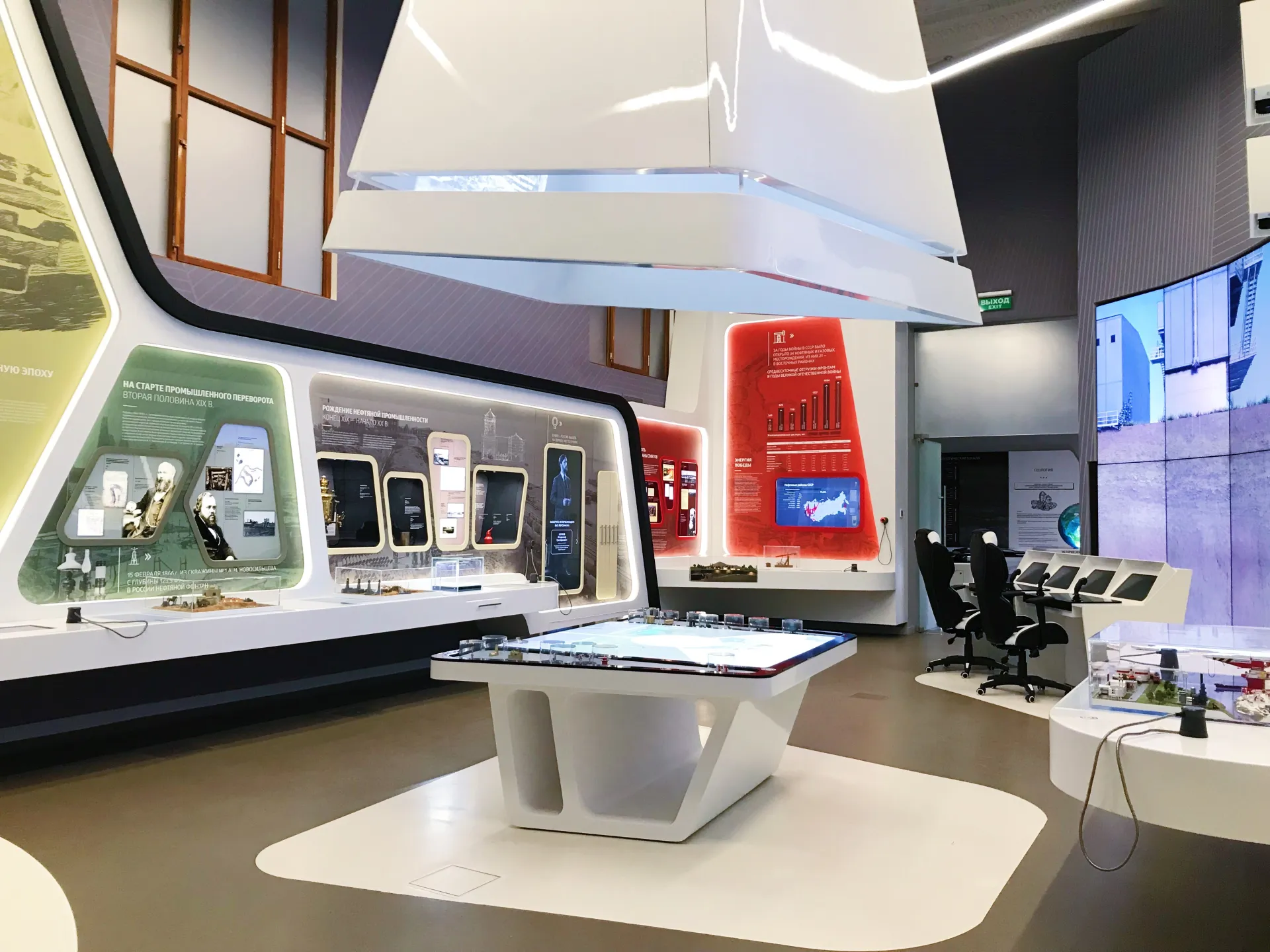
Rather than organising the exhibition around isolated technical objects, the museum was structured as a spatial narrative revealing how geological processes, extraction technologies, refining systems, transportation infrastructure, and energy consumption form one interconnected planetary-scale network shaping modern life.
Narrative architecture was designed around transitions between radically different scales of perception: subterranean geological time, industrial machinery, human labour, global infrastructure, and everyday urban experience.
The visitor journey continuously shifts between these layers, allowing audiences to understand how microscopic organic transformation over millions of years ultimately becomes fuel powering contemporary civilisation.
Immersive multimedia environments, interactive and phygital systems, projection architecture, audiovisual storytelling, kinetic installations, and data-driven interfaces were integrated into one coherent interpretive framework. Rather than functioning as spectacle layered over industrial content, multimedia systems were used as narrative infrastructure making invisible processes physically understandable.
A major curatorial priority was translating abstraction into embodied experience. Geological pressure, drilling mechanics, underground exploration, refining systems, and energy transportation networks were interpreted through spatial media environments allowing visitors to emotionally and physically experience industrial processes usually hidden from public view.
The project also placed significant emphasis on the relationship between human and technological systems. Engineers, workers, researchers, industrial settlements, and the social ecosystems surrounding extraction infrastructures became part of the narrative itself — positioning oil not only as material resource, but as a force shaping entire ways of life.
The result is not a museum explaining oil from the outside, but a spatial interface revealing how energy infrastructure operates beneath the surface of modern civilisation itself.

THE RESULT
The Oil Museum established a new model for how industrial and scientific infrastructure can be communicated through immersive public experience rather than purely technical exposition.
Combining scientific interpretation, multimedia storytelling, immersive environments, and interactive systems, the project transformed one of the least publicly visible infrastructures of modern civilisation into an emotionally engaging cultural narrative about energy, technology, labour, and industrial transformation.
The museum received international professional recognition, including the IPRA Golden World Award, acknowledging its innovative approach to communicating industrial and technological complexity through spatial storytelling and multimedia interpretation.
More importantly, the project demonstrated how museums can function as public interfaces translating hidden systems of modern civilisation into forms that audiences can not only understand intellectually, but experience emotionally and spatially.